

Last verified September 2026
Emma Fletcher, Beauty Editor.
It is half past seven, the roots are flat and faintly greasy, and there is no time for a wash before the day starts. Somewhere in the bathroom cabinet sits a can of dry shampoo, half used, standing next to two others that promised the same thing and delivered patchy white roots or five minutes of lift that fell by lunchtime. The problem is rarely the product itself. Most dry shampoos on the market, whatever the price, work on the same basic principle: a fine starch or clay that soaks up the oil sitting on the scalp. What separates a good result from a chalky, flat one is almost entirely technique: distance, timing, and what happens after the spray settles. Get those three things right and the same £3.99 chemist-shelf can will outperform an expensive one used carelessly.
- Distance matters more than product: holding the can 25 to 30 centimetres from the scalp, rather than close up, prevents the white cast that sends most people back to the shop for something new
- Timing beats quantity: applying at night, before the oil has fully migrated down the hair shaft, gives the powder longer to absorb and needs far less product than a rushed morning application
- Brushing changes everything: working the powder through with fingers or a natural-bristle brush, not just leaving it to sit, is what turns a dusty scalp into hair that looks washed
What Dry Shampoo Is Actually Doing To Your Hair
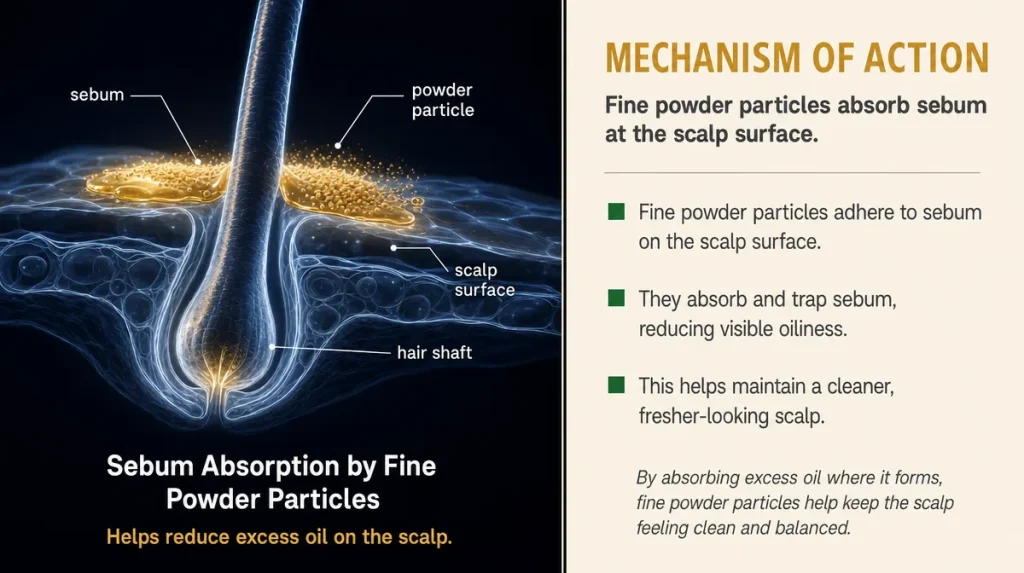
Dry shampoo is not cleaning hair in any real sense. It is closer to blotting paper laid on an oily plate: the starch or clay in the formula, usually rice starch, tapioca, or kaolin, absorbs sebum on contact and then needs to be brushed out along with the oil it has taken up. If it stays in, all that has happened is that the oil has been repackaged as a fine grey dust sitting on the scalp.
This matters because it explains most of the complaints people have. A 2021 study published in the International Journal of Cosmetic Science measured sebum absorption rates across several starch types and found that absorption capacity levelled off within two to three minutes of application, meaning the powder does its job quickly. The mistake most people make is treating dry shampoo like a finishing spray, applying it and moving on, when the real work happens in what follows: brushing, massaging, and giving the product a moment to do its one job before it is disturbed.
Understanding this changes how you use it. There is no benefit to reapplying more product if roots still look greasy two minutes later. The powder has likely absorbed what it can; the issue is more probably that it has not been worked in properly, or that too much oil had already travelled down the shaft before application.
Holding The Can At The Right Distance
The single biggest cause of visible white residue is spraying too close. Most cans are formulated on the assumption of a 25 to 30 centimetre distance from the scalp, roughly the length of a forearm. Held closer than that, the powder lands in a concentrated patch rather than a fine mist, and on darker hair colours this shows up immediately as grey or white flecking along the parting.
A simple self-test: hold the can at arm’s length, close one eye, and check that you can just about read the label at that distance without straining. That is roughly the correct spray distance. Section the hair first, working from the crown outward in the areas that get greasiest fastest, usually the parting and the hairline, rather than blasting the whole head evenly. Most scalps do not oil up uniformly, so treating them as if they do wastes product on hair that did not need it.
For fine or light-coloured hair, a lighter hand works better than a heavier one; for thicker or darker hair, product needs to be worked closer to the roots in smaller sections rather than sprayed in one sweep, simply because there is more hair for the powder to travel through before reaching the scalp.
Why The Night Before Beats The Morning Rush
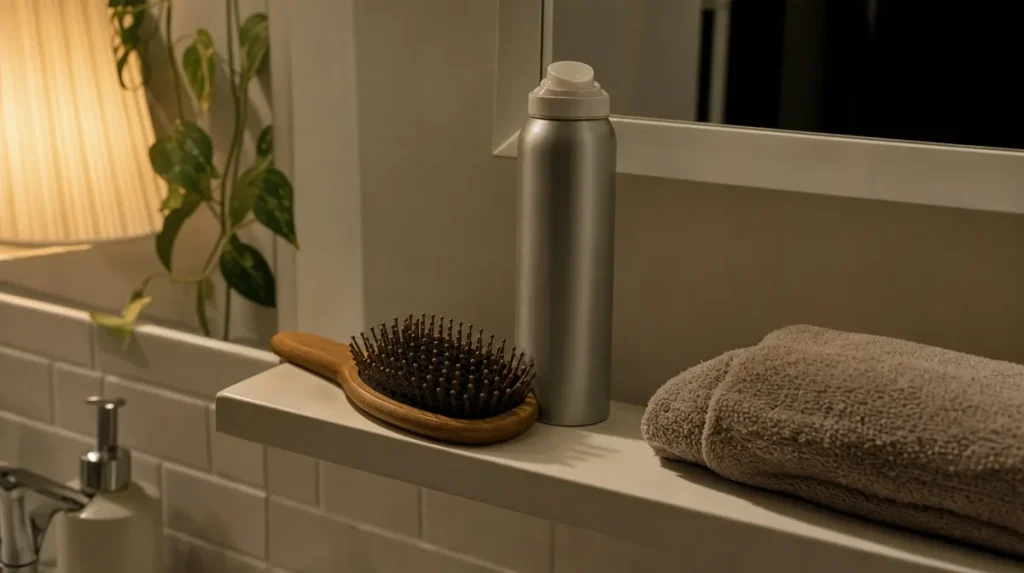
Applying dry shampoo before bed, on hair that is a day old rather than freshly greasy, tends to give noticeably better results than a rushed morning application. Sebum takes several hours to travel from the scalp down the length of the hair, so applying powder while oil production is still relatively low gives it a head start rather than trying to catch up with oil that has already spread.
This is partly why the same can can feel unreliable: used on a fully greasy scalp at eight in the morning, it has far more work to do in far less time than it would the night before. Sleeping on it also allows body heat and the natural movement of a pillow to help distribute the powder through the hair, which is effectively free brushing.
The trade-off is texture. Applied at night, most formulas leave a slightly drier, more matte finish by morning, which some people prefer and others find flat. If a softer finish matters more than maximum grease control, a small top-up in the morning, focused only on the parting, tends to correct this without needing a full reapplication.
The Brushing Step Nobody Does Properly
Spraying is the easy part. Brushing it out is where most of the difference between a good result and a dusty one actually happens, and it is the step people skip because it feels unnecessary.
After application, wait roughly a minute, then work the powder through using fingertips at the roots first, massaging in small circles as if working in a leave-in treatment, before moving to a natural-bristle brush to distribute any remainder through the mid-lengths. Synthetic bristles tend to push powder around on the surface rather than lifting it into the hair; natural bristle, or a boar-and-nylon mix, does a better job of both distributing product and removing the residue the powder leaves once it has absorbed oil.
A useful comparison: think of blusher applied to the cheek. Pressed straight from the compact without blending, it sits obviously on the surface. Buffed in with a brush, the same amount of product looks like natural colour. Dry shampoo behaves the same way. The product has not failed if it looks patchy straight after spraying; it has simply not been blended in yet.
Reading The Results And Knowing When To Actually Wash
A well-applied dry shampoo, used at night on clean-ish hair, can reasonably extend the gap between washes by a day, sometimes two, according to consumer testing summarised by Good Housekeeping’s household advice pages on hair maintenance. It is not a substitute for washing indefinitely, and using it as one tends to cause build-up at the scalp that can, over several weeks, contribute to irritation or flaking in sensitive scalps.
The practical test is simple: run a finger along the parting. If it comes away with a fine, dry residue, the product is still doing its job. If it comes away oily, the hair needs washing rather than another layer of powder. Reapplying dry shampoo onto hair that is genuinely due a wash rarely improves the look, since there is more oil present than the formula is designed to absorb in one pass, and it tends to sit on top rather than working in.
A damp British winter, with central heating running most days, can dry the scalp out more than the cold itself does, which paradoxically can make some scalps produce more oil to compensate. Reading the parting rather than the calendar is a better guide than a fixed number of days between washes.
What Actually Matters In A Formula, And What Is Marketing
Fragrance, tint-matching to hair colour, and claims of added volume are the three things most heavily marketed on dry shampoo packaging, and they vary enormously in how much they matter.
Tint-matching genuinely helps on darker hair, since a formula with a slight tint reduces the visible cast that plain white starch leaves behind; this is a real, testable difference rather than a marketing flourish. Fragrance is almost entirely cosmetic and has no bearing on how well the product absorbs oil, though it does explain why some formulas feel more pleasant to use twice in a row.
Volumising claims are the most overstated. Any dry shampoo will add a degree of texture and lift simply because starch coats the hair shaft and roughens its surface slightly, which is what makes fine hair feel thicker. A dedicated
Key Takeaways
Technique accounts for most of the difference between a dry shampoo that works and one that does not. Distance, timing, and brushing matter more than price or brand. Applying at night on slightly grown-out roots, holding the can at arm’s length, and properly working the product through with fingers and a natural-bristle brush will improve results with almost any formula already sitting in the cabinet.
A Quick Checklist
- Hold the can 25 to 30 centimetres from the scalp, roughly a forearm’s length
- Apply the night before where possible, rather than in a morning rush
- Section hair and target the parting and hairline first, not the whole head evenly
- Wait about a minute, then massage in with fingertips before brushing through
- Use a natural-bristle or boar-and-nylon brush to distribute and remove residue
- Check the parting with a finger before reapplying; oily means it is time to wash
- Choose a tinted formula if hair is dark, since this reduces visible white cast
This article is for general information and does not replace advice from a pharmacist or dermatologist.
Individual results vary depending on hair type, scalp condition, and product formula.