


Last verified September 2026
Emma Fletcher, Beauty Editor.
You are standing at the bathroom mirror with three half-used bottles of foundation lined up on the shelf, none of them quite right. One oxidised orange by lunchtime. One left a grey cast in every photo taken under office lighting. One simply sat on top of your skin like a plaster, cracking round the nose by 3pm. You typed “best foundation for beginners” into your phone at least twice this year and closed the tab both times, no wiser.
Here is the useful fact most people never hear: foundation shade match is not really about the label on the bottle. It is about testing the product against your jawline in daylight, not against the back of your hand under shop lighting. Get that one habit right and half of the usual foundation mistakes disappear before you have even thought about formula or finish.
This guide is not a ranking. It will not tell you which bottle to buy. It will tell you how to work out what your skin actually needs, how to test a shade properly, and which parts of the marketing you can safely ignore.
- Test shade on your jawline in daylight, never on your hand: hand skin is a different colour to your face and shop lighting distorts undertone entirely.
- Finish matters more than coverage percentage: a matte finish on dry skin will look worse than a light layer of the wrong shade in the right finish.
- Skin needs change with the seasons more than most people admit: central heating and damp winters shift what your skin can tolerate underneath foundation.
Finding Your Undertone In Daylight

Undertone is the colour beneath your skin, not the surface tone that changes with a tan or a bit of sun. Most people are warm, cool or neutral, and most shade disasters happen because someone bought a foundation matched to their surface tone rather than what sits underneath.
Think of it like choosing paint for a room with north-facing windows. The tin looks one colour in the shop, and something else entirely once it is on the wall at home. Foundation behaves the same way: it looks different under strip lighting in a chemist than it does by your own window.
The practical test: apply a small stripe along your jawline, not your wrist, and step outside or stand by a window for thirty seconds. If it vanishes into your neck and jaw, that is your shade. If it sits as a visible line, it is wrong, whatever the label says.
A common mistake is matching to the face rather than the jaw and neck, which are usually a shade or two different from cheeks that see more sun. Match too pale to the neck and you get the dreaded mask effect in photographs. This is one of the few beauty steps where five minutes of patience saves months of disappointment.
Reading Your Skin’s Actual Needs Before The Finish
Before choosing a finish, work out what your skin is doing day to day, not what it did five years ago. Skin type shifts with age, weather and even stress, and a foundation chosen for oily 25-year-old skin will sit badly on the same person’s skin a decade later.
A simple self-test: cleanse your face, wait thirty minutes without applying anything, then look at your reflection under natural light. Shine across the whole face suggests oilier skin. Tightness or flaking, especially round the cheeks, suggests dryness. Shine only in the T-zone with normal cheeks is combination skin, the most common pattern in the UK, particularly through damp winters when central heating dries out cheeks while the T-zone still produces its usual oil.
This matters because a foundation formulated for oily skin often contains ingredients that absorb oil, which will make already-dry cheeks look worse, not better. Equally, a rich, dewy formula built for dry skin can slide off oilier areas by midday.
A 2021 study in the International Journal of Cosmetic Science found that self-reported skin type frequently changes across a single year in temperate climates, which is a useful reminder that the foundation that suited you last January may not suit you this one.
Coverage Versus Finish: The Distinction That Actually Matters
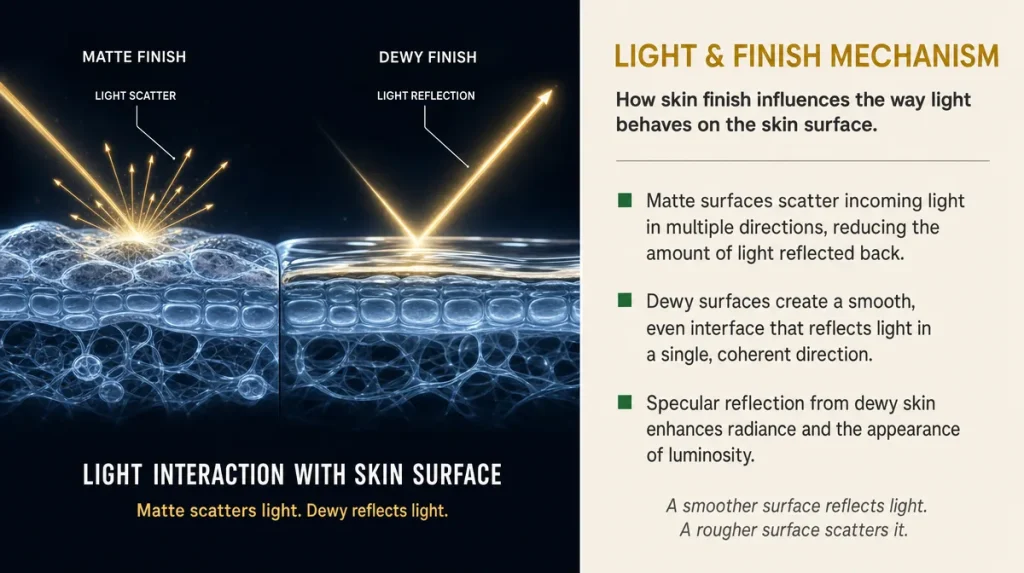
Marketing language around coverage, sheer, medium, full, is often less useful than it sounds, because two “medium coverage” foundations from different brands can look completely different once applied. The finish, meaning how the surface looks once it has set, tends to matter more for how natural or obvious the result looks.
Matte finish sits flat and can look chalky on dry skin, particularly round fine lines. Dewy or satin finish reflects a little light and tends to look more like real skin, but can slide on very oily skin without a setting product underneath.
A useful analogy: think of finish like the sheen on a wall paint, eggshell versus flat matte. The same colour in a different sheen changes how a room looks entirely, even though the tin says the identical shade name.
Coverage can be built with layers regardless of the percentage claimed on the bottle. A thin layer of a “full coverage” foundation, buffed well, often looks more natural than a thick layer of a “light coverage” one applied heavily to disguise redness.
The honest self-test: apply your usual amount, then photograph your face in ordinary daylight without a filter. If the texture looks like paint rather than skin, the issue is usually finish, not the amount used.
Where Cheaper Formulas Genuinely Cut Corners
Cost differences in foundation are real but not always where people assume. The pigment used to create shade ranges is one of the more expensive parts of formulation, which is why budget ranges often have fewer shades and less accurate undertone matching across the range, rather than a worse texture overall.
Another genuine difference is oxidation control. Cheaper formulas sometimes oxidise more visibly after application, meaning the shade goes noticeably darker or more orange within a few hours, because the iron oxide pigments used are less stabilised. This is a real, measurable difference, not simply snobbery about price.
What rarely differs meaningfully is the basic function of a foundation: evening out tone and providing light coverage. A £8.99 foundation from a high-street chemist can do this perfectly well for many skin types.
Where it pays to spend more is usually longevity through a working day and the breadth of shade range, particularly for readers whose skin tone falls between two standard shades. Testing on the jawline, as described earlier, catches most of these problems before you have paid for anything.
Judging Results Honestly: What A Good Match Actually Looks Like
A well-matched foundation should be nearly invisible in ordinary daylight photographs, not glowing or flat, simply unremarkable. If a friend has to ask what foundation you are wearing, that is usually a good sign. If they can tell at a glance that you are wearing foundation, something is off, whether that is shade, finish or amount applied.
Give any new foundation at least a full week of normal wear before judging it, not a single afternoon. Skin behaves differently on a stressful Monday than a relaxed Saturday, and a foundation that looks patchy on one particularly dry day might behave perfectly the rest of the week.
Check your face at three points in the day if you can: mid-morning, after lunch, and early evening. Foundations that look fine at 9am but visibly separate or go patchy by 1pm are usually mismatched to your skin’s oil or dryness pattern, not simply “bad” products.
Results do vary by individual skin chemistry, and what works for a friend with visibly similar skin may behave differently on you. This is normal and not a sign you have done anything wrong.
Marketing Language Worth Ignoring, And Language Worth Trusting
Terms like “skin-perfecting”, “radiance-boosting” or “second skin” describe marketing ambition rather than a testable claim, and are worth ignoring when choosing a product. They tell you nothing about shade range, oxidation or how the formula behaves on your specific skin type.
More useful language to look for on packaging includes explicit finish descriptors (matte, satin, dewy), SPF rating where relevant, and whether the shade range is described in numbers or named tones, since numbered ranges are often easier to match consistently across a brand’s other products.
Good Housekeeping’s consumer testing has long placed weight on wear-time and transfer resistance in its assessments of everyday cosmetics, a useful reminder that longevity claims are worth checking against your own daily wear rather than taking on faith. Which? has similarly published general guidance encouraging shoppers to test cosmetic claims against their own skin rather than relying on packaging language alone.
SPF built into foundation is worth a mention here too. In the UK, with a short and unreliable summer, SPF in foundation matters seasonally rather than as a year-round essential, though many dermatologists note that UVA exposure continues on cloudy days, so it is not something to dismiss entirely from spring through early autumn.
Application Basics That Change The Result More Than The Product Itself
How foundation is applied often changes the result more dramatically than which product is used. A damp sponge, dabbed rather than dragged, tends to give a thinner, more natural layer than fingers or a dry brush, because it removes excess product rather than simply moving it around.
Applying to dry, unmoisturised skin is one of the most common mistakes. Foundation grips unevenly to dry patches, particularly round the nose and chin, creating the flaking look often blamed on the product rather than the skin underneath it. Moisturiser needs a few minutes to absorb properly before foundation goes on, not thirty seconds.
Working in small sections, starting from the centre of the face and blending outward, tends to avoid the harsh demarcation lines that show up round the jaw and hairline, particularly in photographs with flash.
A quick self-test: apply your usual routine, then run a finger lightly along your jawline. If product transfers heavily onto your finger, you have likely applied more than your skin needs, which increases the chance of the finish looking heavy rather than natural by the afternoon.
Key Takeaways
Match on the jawline in daylight, not the back of your hand under shop lighting. Choose finish based on your actual current skin type, checked recently rather than assumed from years ago. Treat coverage percentage as a rough guide only, since finish affects how natural a result looks far more. Cheaper formulas most often cut corners on pigment stability and shade range, not on basic function. Judge any new foundation over a full week of normal wear, checked at more than one point in the day, and remember that individual results vary.
A Quick Checklist Before You Buy
- Test the shade stripe on your jawline, in daylight, not on your hand
- Check your skin type fresh, thirty minutes after cleansing, before assuming a finish
- Choose finish (matte, satin, dewy) based on that check, not on marketing language
- Apply to moisturised skin, in small sections, with a damp sponge if possible
- Wear the foundation a full week before judging it, checking morning, afternoon and evening
- Ignore vague marketing terms; look for finish, SPF rating and numbered shade systems instead
This article is general information and does not replace personalised advice from a dermatologist or skincare professional.
Individual results vary depending on skin type, environment and application method.