


Last verified September 2026
Emma Fletcher, Beauty Editor.
There is a particular moment most women recognise: leaning into the bathroom mirror at half past six, blotting a lipstick that promised sixteen hours and gave four, wondering whether the fault lies with her lunch, her lips, or the product. The bathroom shelf tells the story better than she can: three near-empty tubes of long-wear lipstick, each abandoned for a different reason, none of them quite bad enough to bin.
Here is the useful fact first: most long-wear lipstick failure has nothing to do with the formula wearing off. It is transfer, not evaporation. The colour migrates to a coffee cup, a mask, a collar, and the wearer assumes the pigment has vanished when in fact it has simply moved house. Understanding that single mechanism changes how you shop, how you apply, and how you judge whether a lipstick has actually let you down.
This guide sets out what genuinely determines staying power, which marketing claims are worth ignoring, and how to test any lipstick yourself, on your own lips, before you commit to a full tube.
- Transfer, not evaporation, causes most fading: a lipstick that looks worn off has usually moved onto a cup or mask, which changes how you should judge and reapply it.
- The first ten minutes matter more than the label: how a formula sets in that window predicts the rest of the day better than any ’12-hour’ claim on the box.
- A five-minute in-shop test beats any review: swatch, blot, eat something, and check the back of your hand before you buy, because lip chemistry is personal.
Why Long-wear Lipstick Behaves So Differently From Ordinary Lipstick
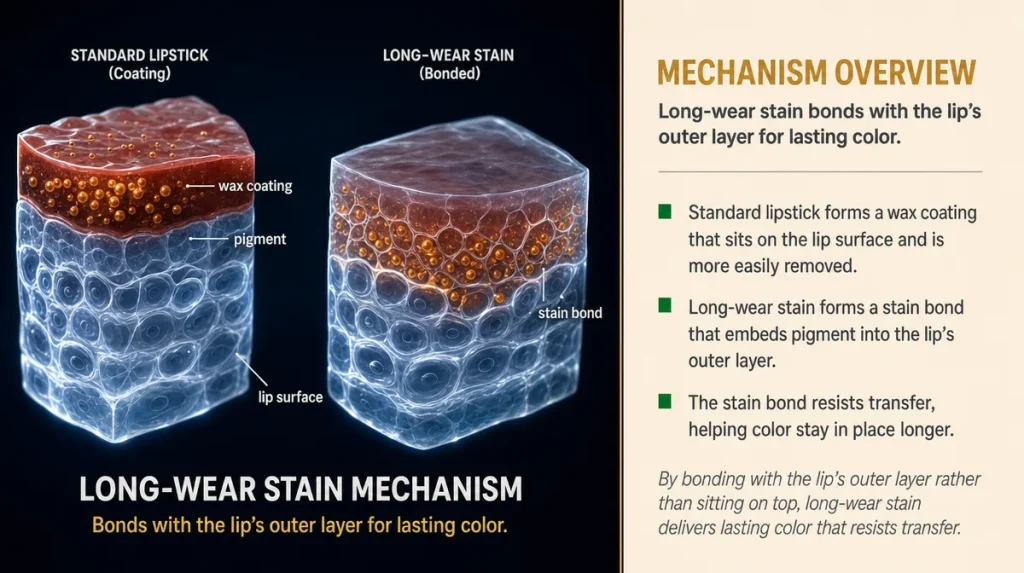
A standard lipstick sits on the lip like a thin coat of wax and pigment, similar to icing on a cake: soft, workable, and happy to smudge onto anything it touches. Long-wear formulas work more like a stain a cabinetmaker rubs into wood. Once it has bonded to the surface, it resists being wiped away, though the surface itself can still feel dry underneath.
That bonding usually comes from a dye rather than a pigment, or from a film-forming ingredient that sets hard once the solvent evaporates. This is why long-wear lipsticks often go on wetter than expected and then seem to disappear within a minute or two: what is actually happening is the setting phase, not the fading phase.
Understanding this distinction matters because it explains a common complaint: ‘it faded in the middle but stayed on the edges’. That is not a formula failure. It is simply where the stain bonded most evenly, usually where lips are driest, and where it bonded least, usually the inner, wetter zone that gets rubbed by the tongue and teeth throughout the day.
Reading The Label Without Falling For The Marketing
Terms such as ’24-hour wear’ or ‘transferproof’ are tested under laboratory conditions that rarely resemble a working day that includes tea, a sandwich, and a face mask on the train. A 2021 study in the International Journal of Cosmetic Science measuring lipstick wear on volunteers found that eating and drinking removed up to 60 per cent of visible colour within the first two hours, regardless of the wear claim printed on the packaging.
What is worth reading on a label: whether the formula is described as a liquid lipstick, a stain, or a traditional bullet. Liquid lipsticks and stains generally outlast bullets because they contain more film-forming or dye content and less oil. What is largely marketing: numbers attached to hours of wear, since no independent body verifies these claims before they reach the shelf at Boots or Superdrug.
Good Housekeeping’s Institute has, in its general beauty guidance, noted that wear-time claims are usually derived from a single controlled test and should be treated as a ceiling figure rather than an expectation for daily life. Treat any number on a box as the best case, not the likely case.
The First Ten Minutes: The Window That Decides Your Whole Day
Most long-wear formulas need to sit undisturbed for several minutes to finish bonding. Talking, drinking, or blotting during that window disrupts the stain before it has set, which is the single most common reason a supposedly long-lasting lipstick fails by lunchtime.
A simple household comparison: it is much like painting a fence and touching it before the paint has cured. The colour looks fine going on, but a careless brush against it in those first minutes leaves a mark that never quite disappears.
The fix is procedural, not a matter of buying a different product. Apply the lipstick, wait a full two minutes, blot lightly with a single tissue, then apply a second thin layer and leave it alone entirely for at least eight minutes before eating or drinking. Reviewers who complain that a lipstick ‘didn’t last’ have very often skipped this waiting period altogether.
Self-test while reading: next time you apply, time yourself. If you are reaching for a drink within ninety seconds of finishing your lips, you are almost certainly undermining any formula, however well made.
Where Cheaper Formulas Actually Cut Corners
Budget long-wear lipsticks are not usually failing on pigment load, which is inexpensive to include. The corners get cut on the film-forming polymers and emollients that keep a stain flexible once it has dried. Without enough of these, the dried layer becomes brittle and flakes rather than wearing evenly, which shows up as visible cracking along the lip line by the afternoon.
The other common shortcut is solvent choice. Cheaper formulas often rely on faster-evaporating solvents that make the product feel drier and more ‘set’ immediately after application, which reads as instant long-wear performance in a quick in-store swatch. The trade-off is that lips underneath are left properly parched within a few hours, particularly in the damp, centrally heated conditions of a British winter, when indoor air is drier than the weather outside would suggest.
This does not mean expensive always means better. It means the swatch test in the following section is genuinely worth doing before you buy, since a five-second look at a formula on the back of your hand tells you more than the price tag does.
Finding Your Undertone In Daylight
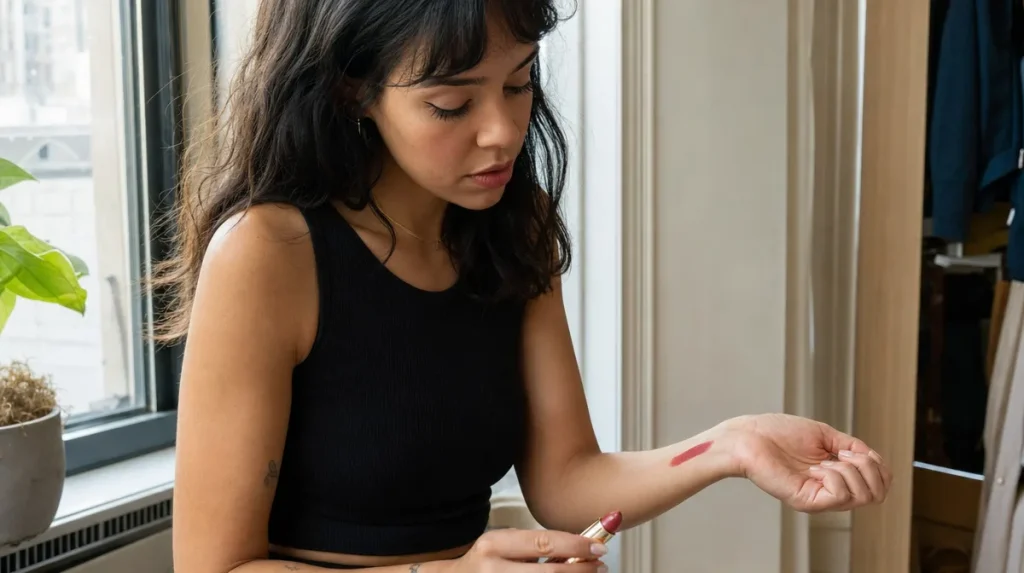
Shop lighting distorts colour more than most people realise, usually pushing warm tones cooler and muting reds into browns. Any swatch tested under fluorescent strip lighting should be checked again near a window or, failing that, on your phone camera with flash off, before you decide.
The practical method: swatch a stripe on the inner wrist, where skin tone is closest to the lip’s natural base, rather than the back of the hand, which tends to be more weathered and less representative. Step towards a window or doorway. If the colour looks orange or muddy indoors but settles into a clean red or berry in daylight, that is the true shade, not the shop’s lighting playing tricks.
A mistake many make is judging a long-wear formula by its wet, just-applied colour. Stains in particular oxidise and often darken by one or two shades over the following ten minutes as they set. Wait before deciding you have the wrong colour.
Judging Comfort Against Wear Time, Honestly
The trade-off nobody puts on the box: the formulas that resist transfer best are also, almost without exception, the most drying. This is chemistry, not a manufacturing failure. A stain needs to dehydrate to bond, and dehydration is the same process that leaves lips feeling tight by mid-afternoon.
The honest way to judge a long-wear lipstick is not by how long the colour survives, but by how your lips feel eight hours in. Visible flaking along the vermillion border, a tight sensation when smiling, or colour settling unevenly into fine lines are all signs the formula is fighting your lips rather than working with them.
A balm or overnight treatment underneath is not a failure of the lipstick’s design, it is standard practice among people who wear these formulas regularly. Marie Claire UK’s beauty desk has, in general skincare guidance, pointed out that prepping lips the way you would prime skin before foundation meaningfully improves both comfort and how evenly a stain wears down.
The Five-minute Test You Can Do Before Buying Anything
Most counters at Marks & Spencer beauty halls or Look Fantastic’s concessions will let you try a tester, and this short routine tells you more than any review column. Swatch a full stripe on the inner wrist. Leave it completely alone for five minutes while you carry on browsing. Then rub it, once, with a clean tissue, applying roughly the pressure of a napkin at lunch.
If the colour smudges into a visible line rather than staying put, the formula is likely to transfer onto cups and collars in normal wear. If it stays largely intact but the skin underneath looks visibly dry or tight, expect the same on your lips by the afternoon.
This test takes less time than reading the packaging and is far more reliable than any wear-time claim, because it uses your own skin rather than a laboratory volunteer’s.
What To Do When A Favourite Lipstick Stops Performing
Long-wear formulas do change over their shelf life, typically 12 to 18 months once opened, as the solvents that keep them workable slowly evaporate even inside a closed tube. A lipstick that wore beautifully in January and feels gluey or patchy by autumn is not necessarily a bad batch, it may simply be reaching the end of its useful window.
A quick check: if the bullet has become noticeably harder to glide on, or separates into a visible sheen and a duller patch when swatched, it is worth retiring rather than troubleshooting your application technique. No amount of careful blotting fixes a formula that has changed chemically in the tube.
Key Takeaways
Long-wear failure is usually transfer, not fading, so judge a lipstick by what ends up on your cup, not by how much colour seems left on your lips. The first ten minutes after application decide more than any wear-time claim on the box. Swatch on the inner wrist in daylight, wait for the colour to set before judging shade, and always run the five-minute rub test before committing to a full tube. Comfort and longevity trade off against each other by design, so balance the two rather than chasing hours alone.
A Short Checklist For The Counter Or The Chemist
- Swatch on the inner wrist, not the back of the hand
- Check the colour again in daylight, away from shop lighting
- Wait five minutes, then rub gently with a tissue to test transfer
- Notice how lips feel, not just how the colour looks, after several hours
- Prep lips with balm beforehand if the formula tends to dry
- Treat any ’24-hour’ claim as a laboratory best case, not a guarantee
This article is general information and does not replace personalised advice from a dermatologist or pharmacist.
Individual results vary depending on skin type, lip condition and application method.