


Last verified October 2026
Richard Osei, Senior Health and Science Editor.
Most mornings begin in bad light: a bathroom mirror, an overhead bulb, half past seven. You dab concealer under one eye, check it, and by the time you reach the hallway it has gone faintly orange. The question that actually gets typed into a search bar late at night is rarely ‘best concealer’. It is closer to ‘why does my concealer go orange’ or ‘why does it crease under my eyes by lunchtime’. One fact worth knowing straight away: most concealers oxidise, meaning the pigment reacts with air and the natural oils on your skin and can darken by a shade or more within twenty minutes of application, which is why a shade that looks perfect in the shop can look wrong by the time you leave it. This guide sets out what genuinely determines whether a concealer suits you: undertone, formula, coverage and the handful of mistakes that undo otherwise good products, so you can judge anything on a chemist’s shelf without buying six before finding the one that fits.
- Shade matching works best at the jawline in daylight, not on the back of the hand, since indoor lighting and hand skin both mislead the eye.
- A concealer that looks right in the pot can darken within twenty minutes of wear, so testing for a few minutes before buying matters more than the label.
- Coverage and texture matter more than the brand on the tube, because a formula suits a skin type and a problem, not a face.
Finding Your Undertone In Daylight

Most undertone confusion starts indoors. Shop lighting is often warm LED or yellow-toned fluorescent, and it flatters almost everything, including the wrong shade. The only honest way to judge a concealer’s undertone is to look at it next to your jaw in daylight from a window, not under a lamp.
Stand near a window at midday if you can manage it. Dab a small amount along the jaw, not the back of the hand, where skin tends to run a shade or two lighter and lacks the warmth of facial skin. Let it sit for a minute. If it reads grey or ashy against your skin, it runs too cool for you. If it sits on top like a slab of peach rather than blending in, it runs too warm.
A useful self-test: photograph your jaw in daylight with and without the concealer, flash off. Compare the two images later, away from the mirror’s flattering angle. The camera judges more honestly than your own eye in the moment, because it has no stake in the outcome.
This single habit, daylight plus jawline plus a photograph, resolves most of the ‘it looked fine in the shop’ complaints before they start.
The Twenty-minute Oxidation Test
Oxidation is simple chemistry, not a flaw unique to cheap products. Most concealer pigments are iron oxides suspended in an oil or silicone base. Once exposed to air, and to the oils and sweat on your own skin, those pigments react and can darken by a full shade within around twenty minutes, a shift a laboratory panel would describe as colour drift.
The mistake nearly everyone makes is buying the shade that looks correct the moment it goes on. Beauty counters rarely allow the twenty minutes needed to see the true colour, so the sensible method is to apply a small amount, carry on with your routine, and judge the shade only once it has settled.
A 2023 study in the Journal of Cosmetic Science examining pigment stability in cosmetic emulsions found that formulas with higher oil content oxidised faster and more visibly than water-based or silicone-based alternatives, which held their original tone for longer. That is worth knowing if a favourite concealer has turned orange by early afternoon: the oil content, not the shade name, may be the cause.
If an assistant will not let you test and wait, treat that as useful information in itself.
Cream, Liquid Or Stick: What The Formula Actually Changes
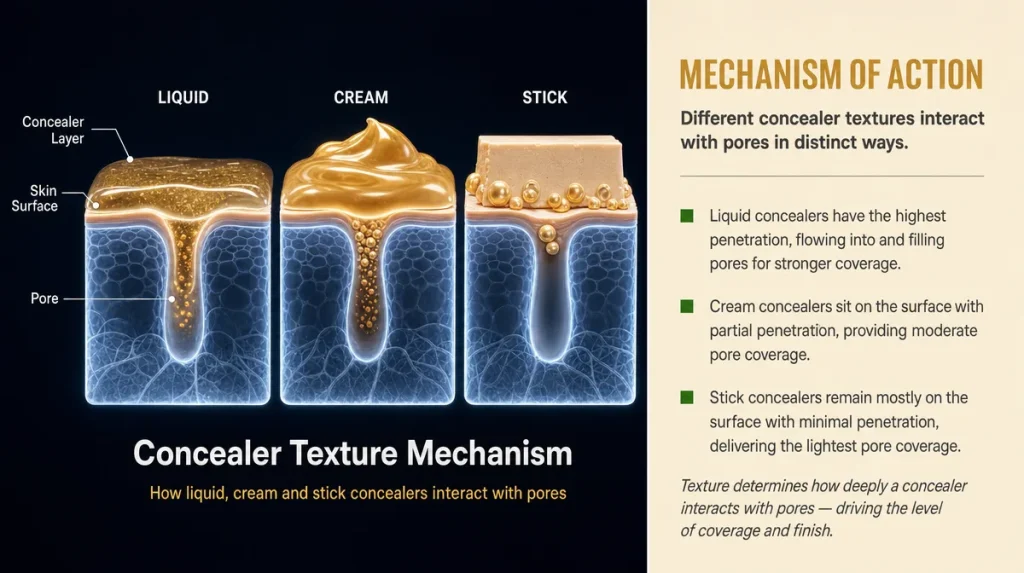
Think of concealer formulas the way a decorator thinks about paint finish rather than colour. Matt emulsion, silk and gloss all come from the same tin of pigment, but the vehicle carrying it changes how it sits on a wall, and the same is true of skin.
Liquid concealers carry pigment in a thin, often water- or silicone-based fluid. They blend easily and sit close to natural skin, which suits fine lines and drier skin because there is less product to settle into creases.
Cream concealers use a thicker, often wax-based vehicle. They carry more pigment per dab, giving stronger coverage, but that same thickness is what later causes creasing if applied too heavily over dry patches.
Stick concealers are the most concentrated, essentially a cream formula set with harder waxes so it holds its shape. They give the most coverage per swipe, which suits blemishes and scarring, but the same density makes them least forgiving on dry or textured skin, where they can emphasise rather than disguise fine lines.
None of the three is objectively better. Each is a different vehicle for the same job, and the right one depends on what your skin is doing that particular week, since damp winters and central heating dry skin out more than cold itself, which changes which formula behaves well from one month to the next.
Where Cheap Concealers Cut Corners
The honest difference between a modestly priced concealer and a considerably pricier one rarely lies in some rare ingredient. More often it comes down to pigment milling and preservation.
Finely milled pigment disperses evenly through the base, which is why a well-made concealer looks smooth straight from the tube. Coarser, cheaper pigment settles unevenly, which is what produces the patchy, slightly grainy look some budget formulas develop within an hour.
Cheaper formulas also tend to use fewer stabilisers against oxidation, part of why some products shift colour faster than others, as the earlier test suggests.
None of this means an inexpensive concealer from Superdrug or Boots is automatically worse. Several budget ranges mill their pigment well and have been flagged favourably in Good Housekeeping Institute’s Tried & Tested reports for wear and colour stability. Price is a weak proxy for quality here. The pigment grade and the preservation system are the real variables, and neither is printed on the box in plain language.
Coverage Versus Texture: The Trade-off Nobody Mentions
Full coverage concealer behaves a little like filler pressed into a cracked wall: it sits in the crack rather than blending into the surrounding surface, and the thicker the filler, the more visible the patch once it sets.
On skin with fine lines, particularly around the eyes, a thick, high-coverage concealer can settle into those lines within an hour and make them more visible than before application, an effect commonly called creasing. This is a texture problem, not an ageing problem, and it can happen on taut skin too if the product is too heavy for the area.
The mistake is choosing coverage level by the size of the flaw rather than the texture around it. A dark circle on drier or more mature skin is usually better served by a lighter, more hydrating formula applied in two thin layers than by one thick layer of maximum coverage. A spot or patch of pigmentation on otherwise smooth skin, by contrast, can usually take a denser, stick-type formula without creasing.
Self-test: apply your usual concealer under one eye only, go about your morning for two hours, then compare both eyes in daylight. If the treated side shows fine lines the other does not, the formula is too heavy for that area, whatever the coverage claim on the packaging promises.
Judging Longevity: The Honest Four-hour Check
Judging a concealer properly takes patience most of us do not give it at the counter. A fair test runs for about four hours, not four minutes.
Apply as you would for an ordinary day, then check in at the two-hour and four-hour marks in natural light. Look for three things: has the colour shifted, has it crept into fine lines, and has it transferred onto a collar or glasses. Transfer is a reasonable sign the formula has not set properly for your skin’s oil level.
The mistake most people make is judging longevity by how the concealer looks straight after application, which tells you almost nothing. A formula can look flawless at ten o’clock and have moved entirely by two.
Setting powder, applied sparingly only where concealer has actually been placed rather than across the whole face, extends wear time for most formulas by slowing the movement of oil underneath. It will not rescue a formula that is fundamentally the wrong texture for your skin, but it buys a genuinely heavy formula a few extra hours before it creases.
What Is Marketing And What Actually Matters
Packaging language is where most of the confusion gets manufactured. ’24-hour wear’ describes a laboratory test condition, not a promise about your own skin, oil levels and climate. ‘Buildable coverage’ simply means the formula can be layered, which is true of almost any cream or liquid product applied in thin layers.
‘Lightweight’ is one of the few claims worth paying attention to, since it usually does describe a thinner, more fluid vehicle, the kind more likely to suit drier or fine-lined skin as discussed earlier. ‘Photo-ready’ and ‘radiant finish’ describe light reflection, generally meaning the formula contains fine reflective particles, genuinely useful under flat indoor lighting but capable of emphasising texture under flash photography, so the same claim can work for one face and against another.
What actually matters, demonstrably, is pigment milling, oxidation stability and vehicle thickness relative to your skin’s texture, none of which appears on the front of the packaging in plain terms. Reading the full ingredient list for early-listed oils versus silicones tells you more than any claim printed above it. Beauty editors at glossies from British Vogue to Stylist have made this same point in their seasonal concealer round-ups: the claim on the front rarely predicts the result on your particular skin.
Tools And Technique: The Five-minute Habit That Changes Everything
The applicator changes the outcome almost as much as the formula does. A finger warms the product slightly before it meets the skin, which helps thin, liquid concealers blend, but it can also drag product off the fine skin under the eye.
A damp sponge, sold cheaply at any chemist, presses product into skin rather than dragging it across the surface, giving a thinner, more even layer and generally proving kinder to fine lines than a finger or a dense brush.
A small, dense brush gives the most control and the most product per stroke, useful for concealing a spot precisely, but it is also the easiest way to apply too much in one place, which is how creasing begins.
The common mistake is using the same tool and the same amount everywhere on the face. A dab under the eye needs less product and a softer tool than a blemish on the cheek needs. Treating the whole face as one problem, rather than several small ones with different textures, is why a concealer that performs perfectly on a spot can still crease under the eye on the very same person, the very same morning.
Key Takeaways
- Match undertone at the jawline in daylight, never on the back of the hand or under shop lighting.
- Wait around twenty minutes before judging a shade, since most pigments oxidise and darken slightly on contact with skin oils.
- Choose formula by skin texture, not by the size of the flaw: thinner formulas for lines, denser ones for spots and even pigmentation.
- Judge longevity over four hours, not four minutes, checking for colour shift, creasing and transfer.
- Treat marketing phrases such as ’24-hour wear’ as laboratory conditions, not personal guarantees.
A Two-minute Checklist Before You Buy
- Test on the jaw in daylight, not the hand under fluorescent light.
- Wait at least twenty minutes before deciding the shade is right.
- Check the ingredient list for where oils sit relative to water or silicone.
- Match the formula’s thickness to the texture of the area you are covering.
- Apply with a damp sponge under the eyes if creasing has been a problem before.
- Wear it through an ordinary four-hour stretch before judging it a success.
This article offers general information and is not a substitute for personal advice from a qualified professional.
Individual results vary according to skin type, formula and application.