


Last verified September 2026
Sophie Marchant, Staff Writer.
You catch sight of your hands somewhere unexpected: gripping a mug on the train, tapping a card reader at the till, holding a phone up to read a message. For a second they look a decade older than your face. This is one of the most common things a dermatology desk hears from readers, and it has a straightforward explanation, plus a workable answer.
The skin on the back of the hand has fewer oil glands and roughly half the thickness of facial skin, so it dries out faster and shows movement and sun exposure sooner. That is not a flaw in your routine. It is basic anatomy, and once you understand it, a hand cream habit stops feeling like one more thing on the shelf and starts working the way a seatbelt does: quietly, in the background, every day.
This guide sets out what genuinely matters in a hand routine that can survive washing up, school runs, hand sanitiser and a British winter, and what you can safely ignore.
- Thin skin needs frequent, thin layers, not one rich application at bedtime.
- Occlusive ingredients beat fragrance and botanical extracts for genuine barrier repair, whatever the label implies.
- Reapplication after washing matters more than the product itself: timing beats brand almost every time.
Why Hands Show Their Age Before The Face Does
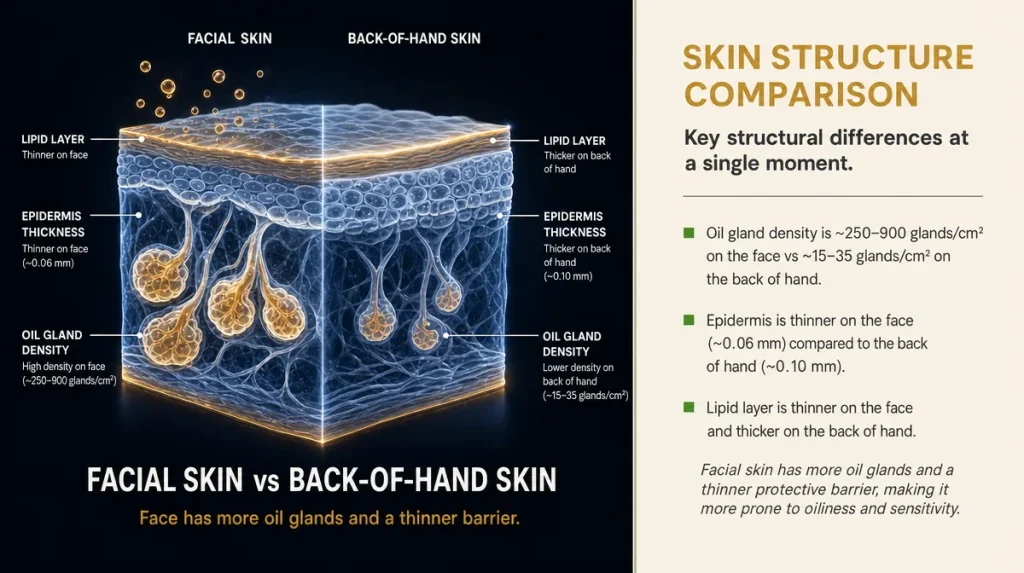
Facial skin has a dense supply of sebaceous glands, which keep it lightly oiled without any help. The back of the hand has far fewer of them, and the skin there is thinner too, closer in structure to eyelid skin than to cheek skin.
Think of it like two coats hung on the same peg. One is lined wool, the other a thin cotton shell. Both get rained on equally, but only one keeps you dry for long. Hands are the cotton shell: exposed constantly to water, soap, cold air and friction, with none of the natural padding the face has.
A 2020 review in the British Journal of Dermatology noted that repeated hand washing, now standard in many workplaces, strips the skin’s outer lipid layer within minutes, and that this layer can take several hours to rebuild unaided. That is the gap a hand cream is meant to close, not with anything exotic, simply by replacing what washing removes before the skin has to do it alone.
This is also why hands often look papery or lined earlier than the face: less natural oil, more visible movement, and near-constant exposure with almost no protection layered on top by default.
The Three-step Routine That Actually Survives A Working Day
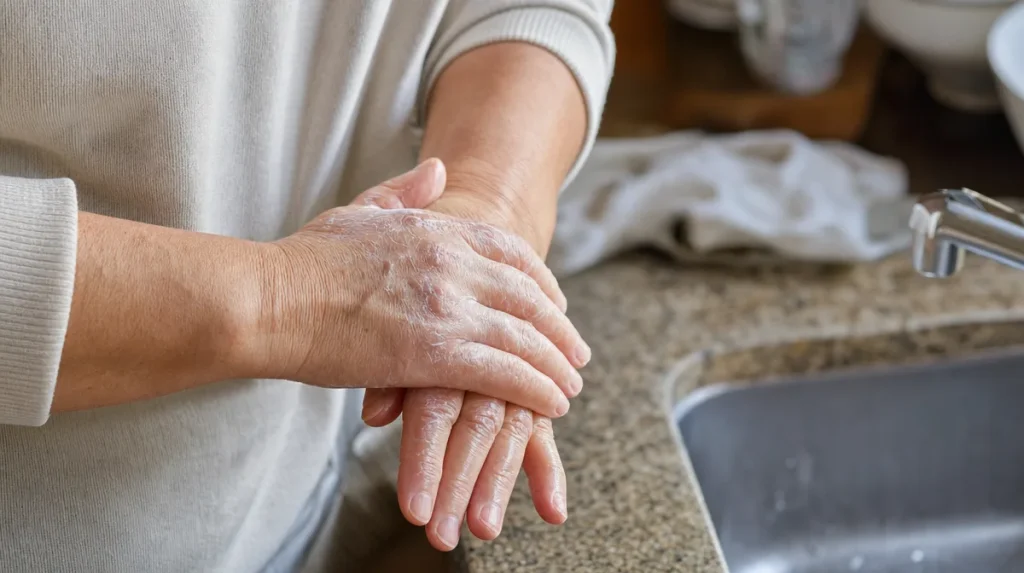
A routine only works if it fits inside a day that includes washing dishes, using a chemist’s hand sanitiser and typing for hours. Three steps, repeated, beat one elaborate step done rarely.
First, apply straight after washing, while the skin is still slightly damp. This is when the surface can hold on to moisture rather than losing it to the air. Pat hands dry rather than rubbing them raw on a towel, then apply immediately.
Second, use a proper amount. Most people use a fraction of what is needed, dabbing a small dot and rubbing it thin. A more realistic amount covers the back of both hands, between the fingers and around the nail fold in a visible, slightly shiny layer that takes a minute or two to sink in.
Third, keep a tube wherever hands actually get washed: by the kitchen sink, in a coat pocket, at a desk drawer. A cream left in a bathroom cabinet at home does nothing for hands washed at work six times a day.
None of this requires a long list of products. One reliable cream, used properly and often, outperforms three expensive ones used occasionally.
Reading A Label Without The Marketing Noise
Hand cream labels lean heavily on words like nourishing, botanical and repairing, which sound reassuring but describe very little. What actually matters falls into three plain categories: occlusives, humectants and emollients.
An occlusive, such as petrolatum or shea butter, sits on the surface and physically blocks water loss, rather like a raincoat. A humectant, such as glycerin or hyaluronic acid, draws water into the skin, more like a sponge pulling in moisture from the air. An emollient smooths the surface in between, filling the gaps between skin cells the way grout fills gaps between tiles.
A cream that works well for chapped hands usually has at least one strong occlusive high on the ingredient list, not buried at the bottom behind a dozen extracts. Fragrance, often the very last ingredient before preservatives, does nothing for the skin barrier and can, in a minority of people, irritate already compromised skin.
The Good Housekeeping Institute’s own testing pages have long pointed out that a shorter, plainer ingredient list is not a downside; it simply means less that can go wrong on sensitive, already-dry skin. That is a useful rule of thumb to carry into any chemist’s aisle.
The Mistakes Almost Everyone Makes
The most common error is speed: rubbing cream in within seconds because hands feel greasy otherwise. Given a minute rather than five seconds, most creams absorb fully and the greasy feeling disappears on its own.
The second mistake is borrowing facial moisturiser for hands, or the reverse. Facial formulas are built for thinner needs and often include actives, such as retinoids, that are wasted on tougher hand skin and can be positively irritating there.
The third is ignoring the cuticles and nail folds, which crack first in cold weather because they have no oil glands at all. A cream that stops at the knuckles leaves the most vulnerable part untreated.
The fourth, and perhaps the most damaging, is skipping reapplication after hand sanitiser. Alcohol-based gels are useful and necessary, but they strip lipids fast. A 2019 study in Contact Dermatitis, tracking 210 healthcare staff over eight weeks, found that pairing sanitiser use with an emollient cream at least four times daily halved reported skin cracking compared with sanitiser use alone. The lesson travels well beyond hospitals: sanitiser and cream are a pair, not a substitute for one another.
When Dryness Is More Than Dryness
Ordinary dryness responds to a better routine within one to two weeks: less tightness, fewer visible flakes, softer knuckles. Genuine irritant contact dermatitis behaves differently, and it is worth knowing the difference.
Signs that go beyond simple dryness include skin that cracks and bleeds, patches that stay red and inflamed for more than a fortnight despite regular cream, or swelling around the nail folds. The British Beauty Council has flagged occupational hand dermatitis, particularly among hairdressers, cleaners and healthcare staff, as a genuine workplace health issue, not a cosmetic complaint.
A 2021 study in the British Journal of Dermatology followed 340 healthcare workers over one winter and found that those washing hands more than fifteen times daily had close to three times the rate of diagnosed irritant dermatitis compared with those washing under eight times. Frequency, not soap brand, was the main driver.
If cream and reduced washing frequency have not helped after a couple of weeks, a pharmacist at a high-street chemist can usually advise on a suitable barrier ointment, and persistent or worsening cases are worth raising with a GP. This is general information rather than a diagnosis, and it is always worth getting a stubborn case looked at rather than assuming it will resolve on its own.
Matching Texture To The Season, Not The Marketing Calendar
Central heating, not cold air itself, is usually the bigger culprit in a British winter. Heated indoor air holds far less moisture than the air outside, which is why hands often feel worse at a desk than on a frosty walk.
A lighter lotion suits most of the year, but from around October a genuinely richer, more occlusive cream earns its place, particularly overnight under cotton gloves for anyone with persistently dry hands. Retailers tend to shift their own ranges accordingly, and it is worth watching for a richer formula going on offer at Boots or Superdrug as the weather turns, rather than paying full price the week it lands on shelf.
Summer needs are more modest in this climate. Given the UK’s short, unreliable summer, SPF on the hands is worth considering mainly on the specific days spent driving, gardening or otherwise exposed for hours, rather than as a year-round layer. Hands that spend most of the day indoors or in sleeves do not need the same protection as a face exposed every morning.
Switching texture with the season is not fussy. It simply matches the product to what the skin is actually contending with that month.
A Thirty-second Self-test For How Much You Are Actually Using
Most people underestimate their own usage by a wide margin. Try this while reading: apply your usual amount of cream as you normally would, then check the back of your hand in good light after thirty seconds.
If the skin looks matte and dry again almost immediately, the amount was too thin. A properly applied layer should leave a faint, slightly shiny film that takes a minute or two to sink in fully, especially around the knuckles.
A second check: press a fingertip gently onto the back of the other hand. If the skin springs back slowly and looks slightly dull rather than plump, that is a fair sign of ongoing dryness rather than a single dry moment, and it points to a routine gap rather than a one-off.
This test costs nothing and takes less time than reading this paragraph, but it tells you more about your actual habit than any label ever will.
Building The Habit So It Actually Sticks
Routines fail not because the product is wrong but because the moment to use it never arrives. The fix is almost entirely logistical rather than cosmetic.
Keep a tube at every sink in the house, not just the bathroom. Keep a second, smaller one in a coat pocket or bag for the sink at work or the one in a public toilet. A cream that lives only in a bedroom drawer will be used once a day at most, at bedtime, when most of the day’s damage has already been done.
Pair the habit with something that already happens daily: cream after the kettle boils, cream after locking the car, cream after the school run. Anchoring a new habit to an old one is a well-documented way to make it stick, and it works just as well for hand cream as for anything else.
Within two to three weeks of consistent use, most people notice softer skin, fewer visible cracks around the knuckles and less tightness after washing. That is a realistic timeline to expect, not an overnight one, and it holds whichever suitable cream you choose to use.
Key Takeaways
- Hand skin is thinner and drier by nature than facial skin, so it needs more frequent, not necessarily richer, care.
- Apply straight after washing, while skin is still slightly damp, and use enough to leave a faint shine for a minute or two.
- Look past fragrance and botanical claims to occlusive ingredients near the top of the list.
- Pair hand sanitiser with cream rather than using either alone.
- Switch to a richer texture as central heating takes hold from autumn, and ease off again by spring.
- Persistent cracking, bleeding or swelling is worth a pharmacist’s or GP’s opinion, not just more cream.
A Short Checklist Before You Change Anything
- Is there a tube of cream within reach of every sink you actually use.
- Are you applying within a minute of washing, while skin is still damp.
- Does the amount leave a faint shine that takes a minute or two to absorb.
- Does the ingredient list have an occlusive near the top, rather than fragrance and extracts alone.
- Have you reapplied after each use of hand sanitiser today.
- Has anything gone beyond ordinary dryness, such as bleeding or swelling, for more than two weeks.
This article is for general information only and does not replace personal medical advice.
Individual results vary depending on skin type, routine and environment.