
Last verified September 2026
Daniel Pryce, Features Reporter.
There is a particular moment most of us know well: stood in front of the bathroom mirror, dryer roaring, hair still damp at the roots twenty minutes in, wondering whether the problem is the hair or the machine. Somewhere in a cupboard there is probably an old dryer from years back, plus a diffuser attachment that has never once been used. The instinct is to blame technique, or product, or the weather. Often it is simply the tool.
A genuinely useful fact to start with: the heat setting does far less work than the airflow. A powerful motor moving a lot of air at moderate heat dries hair faster, and with less damage, than a weaker motor blasting maximum heat at low speed. Understanding that one distinction changes how you shop, how you dry, and how your hair looks by the time you leave the house.
This guide sets out what actually matters when choosing and using a hair dryer, and what to ignore on the box.
- Airflow matters more than wattage: a strong motor moving air efficiently dries hair faster and gentler than high heat alone.
- Heat damage is cumulative, not occasional: the difference between a good and a poor drying habit shows up over months, not after one blow-dry.
- Technique and attachments change the result more than price: a well-fitted concentrator nozzle, a genuine diffuser and the direction you dry in matter more than the brand on the box.
What Wattage Numbers Actually Tell You

Hair dryer boxes lead with wattage: 1800W, 2200W, sometimes higher. It looks like the obvious measure of power, so shoppers gravitate towards the biggest number on the shelf.
Wattage measures how much electricity the motor draws, not how much air it moves or how hot that air gets. A dryer can run at 2200 watts and still push a thin, weak stream of air, because much of that power goes into heat rather than airflow.
What actually dries hair is a mix of airflow volume and heat working together. Airflow evaporates the water; heat just speeds up evaporation. Think of drying a wet towel on a radiator versus hanging it in a breeze by an open window: the breeze alone gets there faster than heat alone, and the two together are quicker still.
Most manufacturers do not print airflow figures on the box, which makes wattage a poor proxy that shoppers rely on simply because it is the only number available. A useful workaround is to check the dryer in person: hold it briefly at arm’s length on the highest speed setting and feel the strength of the air against your palm, not just its warmth.
The practical rule: a mid-range wattage dryer with a strong motor and a well-designed nozzle will usually outperform a higher-wattage model with a weak fan. Price does not reliably track this either, since motor quality varies across similar-looking dryers sold at the same high-street chemist.
How Ionic Technology Changes Drying Time
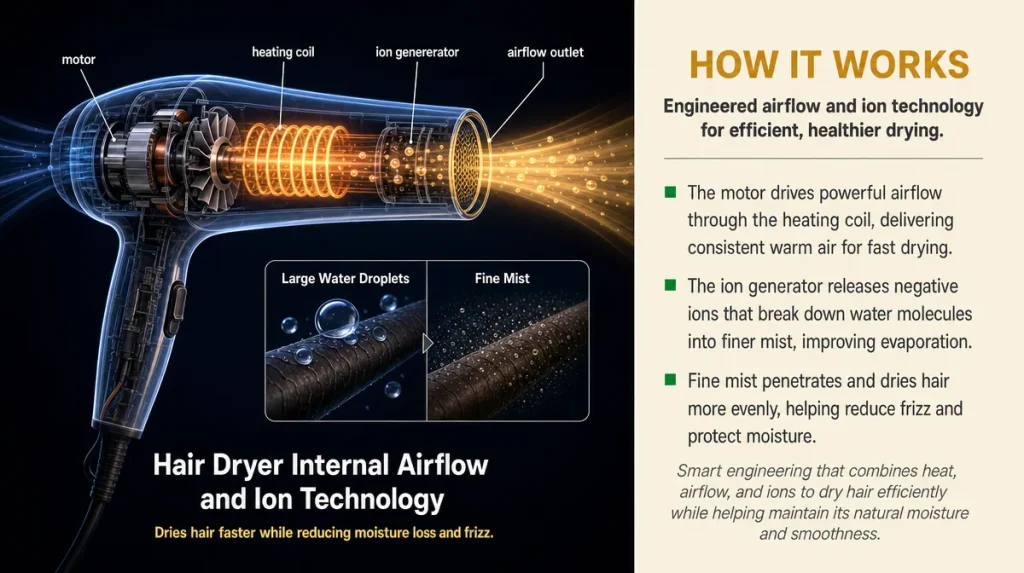
Many dryers now advertise an ionic function, sometimes just called ‘ionic technology’ on the packaging. The idea is straightforward once explained, even though the marketing rarely bothers.
Water molecules on wet hair naturally carry a slight positive charge, which makes them cling together in larger droplets. An ionic dryer generates negative ions that neutralise that charge, breaking water into smaller droplets that evaporate faster and with less need for high heat.
The comparison worth holding in your head: a windscreen covered in large raindrops takes longer to clear than one covered in fine mist, even with the same wiper working at the same speed. Smaller droplets simply leave a wet surface faster.
The practical benefit reported in salon literature and by some hairdressing trade bodies is reduced frizz and a smoother cuticle, because less heat is needed to finish the job. It is not a dramatic transformation, and results vary depending on hair porosity and thickness. Fine, previously coloured hair tends to show the difference more than thick, virgin hair, since damaged cuticles hold water less evenly to begin with.
Ionic function is now common even in mid-range dryers sold at Boots and Superdrug, so it is worth checking the packaging rather than assuming it is a premium-only feature confined to salon brands.
Matching Heat And Speed To Your Hair Type
Most dryers offer two or three heat settings and two speed settings, and the temptation is to default to the highest of both to finish faster.
Fine or fragile hair, including colour-treated hair, generally does better on medium heat and high speed: the strong airflow removes water quickly while the lower heat limits protein damage to the cuticle. Thick or coarse hair can usually tolerate high heat, since it takes longer for heat to penetrate to the hair’s core, but it still benefits from finishing on a cooler setting once mostly dry.
A simple self-test: dry a small section near your hairline on medium heat for thirty seconds, then touch it. If it feels brittle or unusually hot to the touch rather than just warm, drop down a heat level. Hair should feel warm, not hot, at any point during drying.
The most common mistake is holding the dryer close and static in one spot, which concentrates heat rather than distributing it. Keeping the dryer moving, roughly six inches from the head, spreads the heat load and reduces localised damage.
A cool shot button, found on most dryers regardless of price, is worth using at the end: a short burst of cool air sets the hair’s outer cuticle layer flat, which is what gives a finished blow-dry its shine rather than a dull, fluffy finish.
The Attachments That Change The Result
A dryer’s shape at the nozzle end matters more than most buyers expect, and it is the part most likely to be lost or discarded within the first year.
A concentrator nozzle, the narrow attachment that comes with almost every dryer, focuses airflow into a directed stream rather than a wide, scattered one. Without it, air disperses in all directions, lifting hair unpredictably and taking longer to smooth the cuticle in one direction. Losing this attachment is common enough that Boots and Superdrug both stock universal replacement nozzles separately, sometimes on offer alongside other styling tools.
For curly or very textured hair, a diffuser attachment does the opposite job: it spreads airflow gently over a wider area, cradling curls rather than blasting them straight, which reduces frizz caused by disrupted curl pattern. Diffusers are not universal fittings across brands, so it is worth checking that a replacement or upgrade attachment actually fits your specific dryer model before buying one separately.
Neither attachment needs to be expensive to work well. The mechanism is about shape and airflow direction, not material quality, so a basic plastic diffuser performs the same physical job as a premium one costing several times more.
The Technique That Actually Reduces Frizz
Technique accounts for more of the final result than the dryer itself, which is worth remembering before spending on an upgrade.
Start by removing as much water as possible with a microfibre towel or an old cotton t-shirt rather than a standard bath towel, which roughs up the cuticle through friction. Section hair into two or three horizontal layers using clips, working from the lower layers upward, since drying one manageable section at a time gives more even results than drying the whole head at once from the outside in.
Point the nozzle downward, following the direction hair naturally grows from root to tip. Drying against the grain, upward from the tips, lifts the cuticle and is one of the most common causes of visible frizz, even in otherwise healthy hair.
Keep the dryer moving constantly rather than holding it still over one section, and maintain roughly six inches of distance from the head throughout. A stationary dryer held close concentrates heat on a small area and can scorch hair before you notice, particularly around the hairline where hair is often finer.
Finish each section with the cool shot button once it is about eighty per cent dry, letting the last of the moisture evaporate at room temperature. This single step, more than any product applied beforehand, tends to make the biggest visible difference to shine.
Judging Noise And Weight Before You Buy
Two practical factors rarely mentioned on packaging end up mattering most in daily use: how loud a dryer is, and how heavy it feels after five minutes of continuous holding.
Noise is measured in decibels by some manufacturers, though not consistently, which makes in-store comparison more reliable than reading specifications online. Which? has published general guidance in the past on comparing appliance noise levels using a smartphone decibel app in-store, a method that works reasonably well for hair dryers too, held at arm’s length under similar conditions to how you would use it at home.
Weight matters more than most buyers anticipate, since a dryer is held with an extended arm for several minutes at a stretch. A model that feels fine when picked up briefly in a shop can feel considerably heavier by the end of a full blow-dry. If possible, hold any dryer under consideration for a full sixty seconds in the shop rather than a quick lift, and pay attention to where the weight sits: dryers with the motor in the handle, rather than the head, tend to feel better balanced over time.
Cord length is a smaller but genuine annoyance: anything under two metres often proves too short for a socket positioned away from the mirror.
Signs It Is Time To Replace Your Dryer
Hair dryers do not usually fail dramatically. They tend to decline gradually, which makes it easy to keep using one well past its useful life.
The clearest warning sign is a burning smell on start-up, which usually indicates dust build-up on the internal heating element or, less commonly, a failing motor, and warrants stopping use immediately. Good Housekeeping’s consumer advice pages have long recommended checking appliance cords regularly for fraying or exposed wire, a habit worth applying to hair dryers given how often the cord flexes near the plug during use.
A dryer that takes noticeably longer to dry hair than it once did, without any change in hair length or thickness, usually signals a weakening motor or a filter clogged with dust and product residue. The rear intake filter, if the dryer has a removable one, benefits from a quick clean with an old toothbrush every few months; a blocked filter starves the motor of air and forces it to work harder for a worse result.
As a general guide, a well-maintained mid-range dryer used a few times a week should last three to five years before performance drops meaningfully.
What Is Marketing And What Actually Matters
Packaging language has grown more elaborate over the past decade, and not all of it reflects a meaningful difference in performance.
Claims about tourmaline or ceramic coatings on the internal barrel are generally about even heat distribution rather than a dramatic difference in hair health, and a 2023 study in the Journal of Cosmetic Science found that heat distribution had a measurable but modest effect on cuticle damage compared with total heat exposure time, which technique controls more directly than barrel coating does.
Negative ion counts, sometimes printed as a specific number on packaging, are not independently verified by any UK regulator, so treat a printed figure as a marketing claim rather than a tested specification.
‘Salon-grade’ or ‘professional’ on a label has no fixed technical definition in the UK market and can be applied to dryers across a wide range of quality and price.
What reliably matters, based on the mechanisms already covered, is motor strength and airflow, a genuine ionic function rather than a decorative claim, a nozzle attachment that fits securely, and manageable weight for extended handling. Everything else, from casing colour to styling flourishes, is a matter of preference rather than performance, and worth deprioritising against those four points when comparing models on a shelf.
Key Takeaways
- Airflow and motor strength do more work than a high wattage figure printed on the box.
- A genuine ionic function can reduce frizz and drying time, though the effect varies with hair porosity.
- Technique, particularly drying in the direction of hair growth and finishing with a cool shot, changes the result more than most product choices.
- Weight and noise, tested in person for at least a minute, predict daily satisfaction better than specifications on a label.
A Quick Checklist Before You Buy Or Replace A Dryer
- Hold the dryer at arm’s length on full speed and feel the strength of the airflow against your palm, not just the heat.
- Check that a concentrator nozzle is included and fits securely, and confirm diffuser compatibility if you have curly or textured hair.
- Hold the dryer for a full sixty seconds in the shop to judge real handling weight.
- Compare noise in person rather than relying on printed decibel figures.
- Clean the rear intake filter every few months if your dryer has one.
- Watch for a burning smell, a fraying cord, or a noticeable drop in drying speed as signs it may be time to replace the appliance.
This article is for general information and does not replace advice from a qualified professional.
Individual results vary depending on hair type, condition and drying technique.