


Last verified September 2026
Daniel Pryce, Features Reporter.
You are standing at the bathroom mirror with the light doing you no favours, mascara wand in hand, and the same question comes up again: why does it look thick and glossy for the first hour and clumped by the time you reach the office. The drawer under the sink tells its own story, four or five half-used tubes, each abandoned after a fortnight because the formula went dry or flaked under the eyes by noon. None of that is really about the mascara itself. Most of the disappointment comes from six or seven small habits that nobody ever explains properly, from how the wand is pumped to how the tube is stored. Sort those out and a perfectly ordinary volumising formula from the chemist shelf will outperform an expensive one used badly. This piece works through where volume actually comes from, the moments where most people go wrong, and how to judge whether a formula is working before you write it off.
- Thin layers beat one thick coat: volume builds by adding several fine passes with drying time between them, not by loading the brush once and dragging it through.
- Pumping the wand dries the tube out early: air pushed in with every pump thickens the formula and shortens its working life to a matter of weeks rather than months.
- The three-month limit is about bacteria, not performance: mascara that still looks fine can still be carrying enough microbial growth to irritate the eye, particularly for contact lens wearers.
Why Volume Disappears By Lunchtime
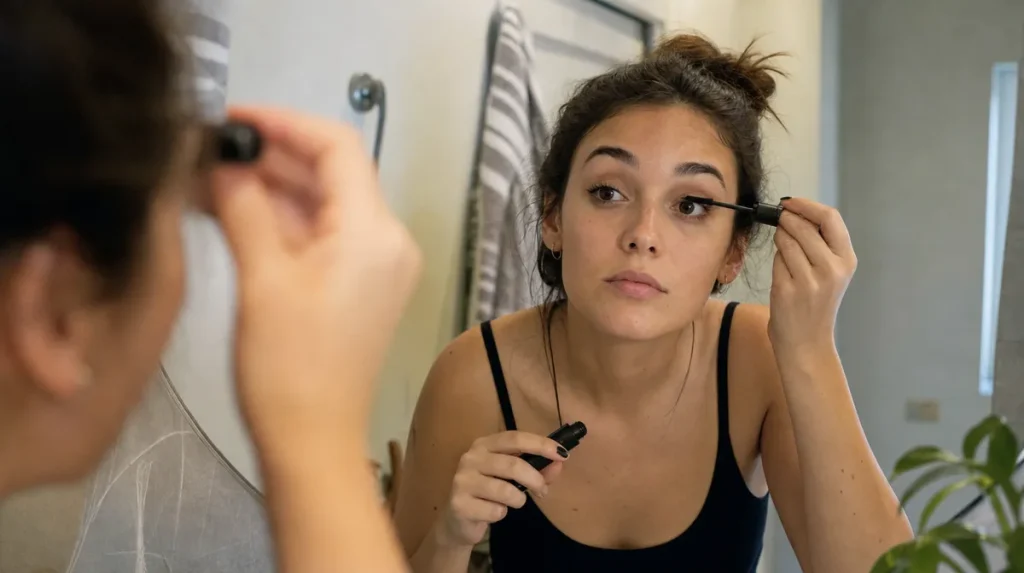
Volumising formulas work by coating each lash in a layer of waxes and polymers, sometimes with tiny fibres suspended in the mix, so that the lash reads as thicker than it actually is. Think of it like painting a fence rail: one heavy, dragging stroke pools in the low spots and leaves the high spots bare, while two or three light passes, allowed to tack between coats, cover evenly and dry hard.
Most people do the opposite. They load the wand once, drag it from root to tip in a single slow stroke, and wonder why the result looks clumped within the hour. A thick wet layer takes far longer to set than a thin one, and while it is still soft it picks up oil from the skin and moves.
A 2021 study in the International Journal of Cosmetic Science measured how coating thickness affected flaking over an eight-hour wear period and found that formulas applied in multiple thin layers held their shape visibly longer than the same formula applied in one pass. The chemistry had not changed. Only the application had.
The practical fix is patience rather than product. Apply one thin coat, wait roughly fifteen seconds, then apply a second. If you want more definition at the outer corner, add a third pass there only, wiggling the wand at the base of the lashes rather than dragging it along the length.
The Pumping Habit That Kills A Tube Early
Pumping the wand in and out of the tube before applying is close to universal, and it is one of the fastest ways to ruin a mascara. Every pump pushes a small volume of air into the tube. That air carries moisture and, more importantly, it dries the formula from the inside out, thickening it within a few weeks rather than the two to three months a well-stored tube should last.
A useful comparison is a tin of paint left open overnight: the surface skins over and the whole tin becomes harder to work with, even though most of it is still liquid underneath. A mascara tube behaves the same way once air gets trapped inside it repeatedly.
The better habit is to twist the wand gently as you withdraw it, letting the tube’s own wiper ring clean the excess formula off the wand, rather than plunging it up and down. It looks less satisfying but it roughly doubles how long a tube stays at its best consistency.
If a formula has already thickened, resist the temptation to add water or saline to loosen it. That introduces bacteria and dilutes the preservative system that keeps the product safe near the eye. A thickened tube is nearing the end of its working life, and that is the moment to replace it rather than revive it.
Matching The Wand To Your Lash Pattern
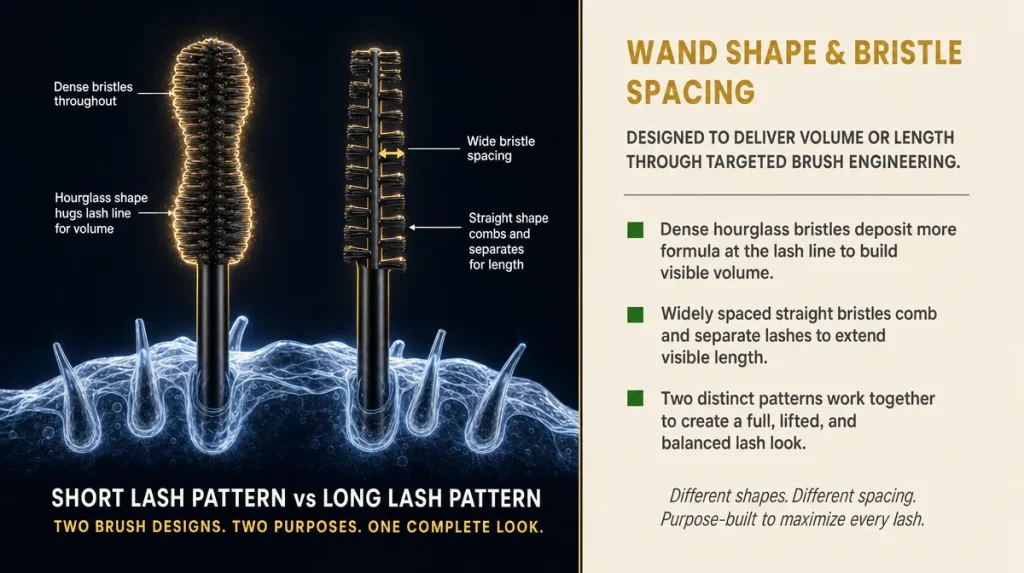
Brush shape does more work than most formulas get credit for. A tightly packed, hourglass-shaped brush is built to grip short or sparse lashes and distribute product evenly along a small surface area. A wider, looser bristle spacing suits lashes that are already long, separating them rather than clumping several together.
The mismatch is common: someone with short, straight lashes reaches for a big, loosely spaced wand designed for separation, and finds that the product barely touches the lash line. Someone with long lashes uses a dense, tightly packed wand meant for volume, and ends up with a spider-leg effect because too much product is deposited too fast.
A quick self-test while you read this: look at your lashes side-on in a hand mirror. If the visible lash length above the lid is under about 6mm, you are working with short lashes and want a smaller, denser brush. If the lashes visibly curve well past the lid margin already, a straighter, more widely spaced brush will separate rather than glue them together.
Brush shape is printed on the packaging as a rule, but it rarely explains what the shape is for. It is worth reading the description rather than the front-of-pack claim, since “volumising” and “lengthening” tubes are frequently sold with the wrong wand for what the formula inside is actually good at.
Curl First, Colour Second
The order matters more than the tools. Curling lashes after mascara has been applied risks snapping lashes at the point where the formula has already begun to set, because dried polymer does not flex the way a bare lash does.
The sequence that actually works with the hair’s structure is: curl first, while the lash is dry and pliable, hold the curler closed for a slow count of ten rather than a hard squeeze, then apply mascara once the curl has had a few seconds to set. Heated lash curlers, now common on the high street, extend how long a curl holds because gentle heat resets the lash’s natural bend the way a curling iron works on hair, but they still need to be used before product, not after.
A common mistake is curling too close to the tip rather than the base. Lashes bend most naturally near the root, so a curler positioned at the very base of the lash line, moved outward in small clamps, gives a rounder, more lifted curl than one squeeze at the tips, which tends to produce an obvious kink rather than a curve.
If lashes drop within a few hours regardless of technique, that is usually a curl-retention issue rather than a mascara one. A water-resistant top coat, applied over an ordinary volumising formula, often holds a curl longer than switching mascaras entirely.
What The Label Actually Promises Versus What It Delivers
Terms like “fibre technology”, “buildable volume” and “lash-plumping complex” describe real mechanisms, but they are marketing shorthand for fairly simple chemistry: waxes to coat and thicken, film formers to hold the shape, sometimes short synthetic or natural fibres that cling to the lash and add apparent length.
The useful distinction is between formulas built around wax content, which tend to give a fuller, softer look but can smudge in humidity, and formulas built around film-forming polymers, which set harder, resist smudging, and are usually the ones marketed as tubing or long-wear.
Good Housekeeping’s beauty testing has previously noted that wear-time claims on mascara packaging are tested under controlled conditions that rarely match a full working day of blinking, rubbing and weather, which is a fair caveat to keep in mind when a tube promises sixteen-hour wear.
None of this means marketing claims are false. It means they describe best-case conditions. A humid commute, an oily lid, or lashes that have not been properly degreased before application will all shorten wear time regardless of what the box says. Reading the ingredients list for wax versus polymer content tells you more about likely performance than the front-of-pack claim does.
The Three-month Rule, And Why It Is Not About Performance
Mascara is one of the few beauty products with a genuinely firm shelf life once opened, generally two to three months, and the reason is hygiene rather than the formula losing potency. The tube is repeatedly exposed to air and to the lash line itself, which introduces bacteria with every use.
A formula can still look and apply perfectly well at month four while carrying enough bacterial growth to cause irritation, particularly for anyone who wears contact lenses or has sensitive eyes. Public guidance from bodies including the British Beauty Council has flagged eye-area cosmetics specifically because the eye has less natural defence against bacterial contamination than skin elsewhere on the face.
A simple way to track this without relying on memory is to write the date opened on the base of the tube with a fine marker the day you first use it. Most tubes list a small open-jar symbol with a number of months printed inside, and that number is worth taking literally rather than as a rough guideline.
It is also worth noting that mascara does not need to be kept in the fridge, despite the occasional suggestion online. Cold temperatures can affect the wax structure and make application harder, and refrigeration does nothing to slow the bacterial growth that the three-month limit exists to manage.
Removing It Without Pulling Lashes Out With It
How mascara comes off matters almost as much as how it goes on. Scrubbing at the eye with a dry cotton pad, particularly with a water-resistant or fibre formula, pulls on lashes that are still bonded to dried polymer, and repeated pulling over months is a common, under-discussed cause of thinning lash lines.
An oil-based remover, or a micellar formula designed for the eye area, breaks down the waxes and film formers without friction. The method that works with the least pulling is to soak a cotton pad, press it against closed lashes for a slow count of ten, and only then wipe downward in one motion, rather than rubbing side to side.
For stubborn tubing formulas, which are designed specifically to resist water and rubbing, a dedicated tubing-mascara remover works with far less effort than an ordinary makeup wipe, because it targets the specific polymer these formulas use rather than relying on oil alone.
Overnight removal matters more than most people treat it. Sleeping in mascara, even occasionally, dries the remaining product further onto the lash overnight and makes the following morning’s removal rougher, which compounds the pulling problem rather than solving it.
Giving A Formula A Fair Trial Before Judging It
A single disappointing morning is not a fair test of a mascara. Humidity, how well the lash line was cleaned beforehand, sleep, and even how recently lash extensions or a lash lift were done can all affect how a formula performs on a given day.
A more useful trial runs for around two weeks, applied with the layering and curling order described above, judged against three questions: did it hold shape past the mid-afternoon without flaking under the eye, did it wash off without heavy rubbing, and did the brush shape suit the lash pattern once you had used it enough times to apply it properly. Individual results vary, and a formula that performs poorly on day one sometimes performs considerably better once the application technique has settled.
It is worth testing in daylight rather than under bathroom spotlights, which flatten texture and make even a good application look patchy. A glance in natural light near a window, an hour or two after application, gives a much more honest read than the mirror check taken thirty seconds after finishing your face.
Key Takeaways
Volume comes from technique as much as formula: thin, patient layers outperform one heavy coat, and a wand shape matched to your own lash pattern matters more than any front-of-pack claim. Small habits, particularly not pumping the wand and removing product gently rather than scrubbing, extend both the life of a tube and the health of the lashes underneath it. The three-month limit exists for hygiene, not performance, and is worth respecting even when a formula still looks fine.
A Quick Checklist To Run Through
- Curl before applying, holding at the base for a slow count of ten
- Twist the wand out of the tube rather than pumping it
- Apply two to three thin coats, allowing each to tack before the next
- Match brush density to lash length: dense for short lashes, wide-spaced for long ones
- Remove with an oil-based or micellar formula, pressed rather than rubbed
- Replace the tube two to three months after opening, regardless of how it still looks
- Judge a new formula over two weeks in daylight, not after one bathroom-mirror check
This article is general information and does not replace advice from an optician, dermatologist or eye care professional.
Individual results vary depending on lash type, application technique and product storage.