


Last verified November 2026
Sophie Marchant, Staff Writer.
There is a particular moment familiar to most dressing tables: a row of near-identical pink and blue bottles, a cotton wool pad that still comes away grey after three swipes, and the question nobody quite knows how to answer, which one actually works. Micellar water looks deceptively simple, a clear liquid that promises to lift makeup, sun cream and city grime without a rinse. But the specialists who assess these formulas for a living do not reach for the prettiest label. They check a short, specific list of things, and once you know what those are, you can read almost any bottle on the shelf at Boots or Superdrug in under a minute and have a fair idea of what you are buying.
One genuinely useful fact to start with: the cleansing power of a micellar water has almost nothing to do with how much foam or fragrance it carries, and almost everything to do with the type and concentration of surfactant doing the actual work. A formula that smells of nothing and foams not at all can still outperform a heavily scented one on a stubborn patch of waterproof mascara.
- The ingredient list tells you more than the front label: terms like ‘micro-filtered’ or ‘spring water base’ describe marketing, not cleansing strength; the surfactants listed mid-way down the list do the real work.
- A cotton pad is a diagnostic tool, not a formality: how many swipes it takes to come away clean, and whether it stays damp or dries sticky, tells you more than any claim on the bottle.
- Residue left behind matters more than foam produced: a good micellar water rinses clean off a mirror when wiped, while a poor one leaves a faint film you can feel with a fingertip.
What A Micelle Is Actually Doing On Your Skin
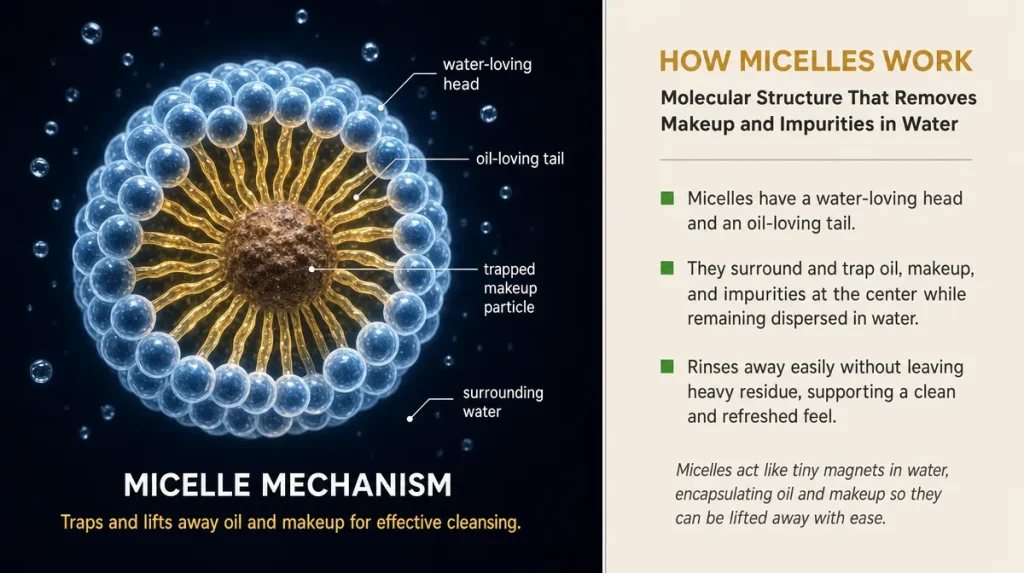
Picture washing-up liquid lifting grease off a roasting tin without hot water. That is broadly the trick a micellar water performs on your face, at a gentler concentration and a kinder pH.
Each surfactant molecule in the water has two ends: one end is drawn to water, the other to oil. Left in water at the right concentration, thousands of these molecules arrange themselves into tiny spheres called micelles, oil-loving tails pointing inward, water-loving heads facing out. When the liquid touches a smear of foundation or sun cream, the oily grime gets pulled into the centre of these spheres and suspended there, rather than simply smeared further across the skin.
This is why a micellar water needs no rinsing in principle: the dirt is trapped inside the micelle, not just diluted on the surface. In practice, as the chapters below explain, how well this works depends heavily on concentration and on what else is mixed in.
Reading The Ingredient List Before The Front-of-bottle Claims
Most shoppers read the front of the bottle. Specialists read the back.
Look for the surfactant names rather than the descriptive copy. Mild, skin-friendly ones such as poloxamers or certain sugar-derived surfactants tend to sit a few places down an ingredient list. If the first few ingredients after water are simply more water-soluble fillers and fragrance, the formula likely relies on a weaker cleansing base and will need more swipes to do the same job.
Glycerin or similar humectants near the top are a good sign for comfort, since they help the skin hold moisture while the surfactants work. Alcohol denat. high on the list is worth noting too: it helps a formula feel light and dry faster, but it can be drying with repeated use, particularly through a damp British winter when central heating is already pulling moisture from skin.
Terms like ‘micro-filtered water’ or ‘French pharmacy formula’ describe origin or marketing positioning, not performance. They are not meaningless, but they tell you nothing about how the product will behave on your own skin tonight.
The One-minute Patch Test Specialists Do First
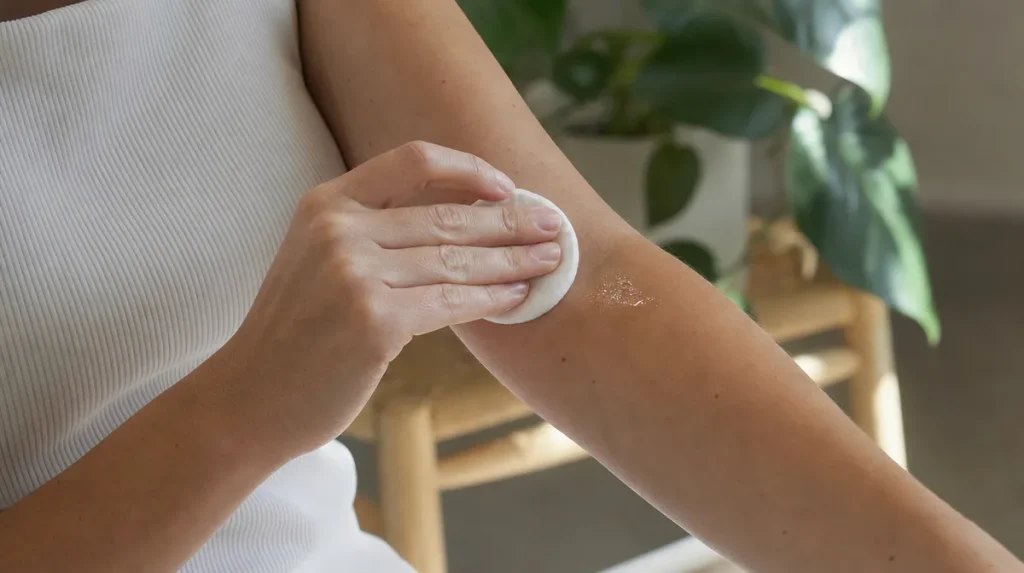
Before judging anything else, dermatology practice is to test a new formula on a small, discreet patch of skin, typically the inner forearm, and wait twenty to thirty minutes before deciding anything.
Apply a small amount with a cotton pad, let it air dry, and watch for redness, tightness or itching. This matters more for micellar waters than most people assume, because surfactants, even mild ones, are the ingredient class most likely to cause irritation with repeated daily use on the face.
If nothing happens on the forearm, it is reasonable to try a small area near the jaw before using the product across the whole face. This two-step habit costs a few minutes and avoids a week of unexplained redness later.
A 2021 study in the British Journal of Dermatology found that surfactant-related irritation was the most commonly reported adverse reaction to no-rinse facial cleansers among adult women surveyed, which is a reasonable argument for patience over enthusiasm when trying something new.
What The Cotton Pad Is Actually Telling You
Hold a used cotton pad up to the light after cleansing. This single habit tells you more about a formula than a week of reading reviews.
A pad that comes away grey or tinted after one or two gentle swipes, with no rubbing required, suggests a formula with an effective surfactant concentration. One that needs five or six passes, with visible pulling on the skin, suggests a weaker base that is relying on mechanical friction rather than chemistry to do the work.
The common mistake is rubbing harder when the first pad does not come away clean. This does not improve the chemistry, it simply irritates the skin and can disturb the surface barrier, something specialists in ageing skin are particularly wary of recommending.
The better habit is to use a fresh pad, let the liquid sit on the skin for a few seconds before wiping, and judge the formula on how many fresh pads it genuinely takes, not on how hard you scrubbed with the first one.
Matching The Formula To Your Skin, Not The Marketing
Oily and combination skin generally tolerates a slightly stronger surfactant blend without complaint, and can benefit from a formula with a higher proportion of cleansing agents relative to soothing ones.
Dry and sensitive skin, by contrast, does better with a formula where glycerin or panthenol sit high on the ingredient list, and where alcohol denat. is absent or listed well down the page. This becomes more relevant through a damp British winter: central heating dries the air indoors far more than the cold outside does, and a stripping formula used daily in that season can leave skin visibly tight by February.
Skin described as reactive or easily flushed usually does better avoiding fragrance altogether, since fragrance compounds are a recognised, if often overlooked, contributor to facial redness noted in general NHS skincare guidance.
None of this requires an expensive formula. It requires matching the surfactant and humectant balance to what your own skin actually does through the seasons, which is a more useful filter than price or packaging.
The Mistakes That Undo An Otherwise Good Formula
Even a well-formulated micellar water can underperform because of how it is stored and used, not because of what is in the bottle.
Keeping a bottle on a steamy bathroom windowsill, rather than in a cupboard, exposes it to repeated heat cycles that can degrade some surfactants and preservatives faster than the use-by date suggests. A bottle that has sat open for six months through a warm summer may simply not perform as well as it did when new.
Another common mistake is decanting a small amount onto a pad and then dipping the same pad back into the bottle, which can introduce bacteria over time. Pouring a small amount directly onto the pad each time avoids this.
Finally, people often judge a formula on a single evening’s use, after a long day of full makeup and SPF, and conclude it does not work. A fairer test is a lighter makeup day, since even an excellent micellar water will need a second cleanse after heavy, long-wearing coverage, which is a formulation limit, not a failure.
Judging Whether You Still Need A Second Cleanse
Micellar water was never designed to replace a proper cleanse entirely for every skin type and every makeup load, and specialists tend to judge this by particle size rather than habit.
Lightweight, water-based makeup and most daily SPF lift away with micellar water alone in most cases. Long-wearing foundation, waterproof mascara and heavier contour products contain film-forming polymers designed specifically to resist water and light surfactants, which is precisely why they survive a long day. These tend to need a follow-up balm or oil cleanse to fully dissolve.
A simple self-test: cleanse as usual, then wipe the face once more with a fresh white cotton pad. If it still shows colour, a second cleanse was needed and skipping it tonight means residue sitting on skin overnight.
A 2022 review in the Journal of Cosmetic Dermatology noted that double cleansing improved removal of long-wear cosmetic formulations compared with a single micellar pass, which supports treating micellar water as the first step on heavier makeup days, not the only one.
What Genuinely Matters Versus What Is Marketing Noise
Phrases such as ‘no-rinse formula’, ‘gentle enough for eyes’ and ‘suitable for sensitive skin’ appear on the vast majority of bottles, which makes them close to meaningless as a point of difference.
What actually separates formulas, in order of real importance, is surfactant type and concentration, the presence and position of humectants like glycerin, whether alcohol denat. features and how high, and fragrance load. A formula that is genuinely eye-safe will usually carry an ophthalmologist-tested note specifically, rather than a general sensitive-skin claim, since eye tissue is assessed separately in formulation testing.
pH claims are worth a glance but not obsession: skin’s natural surface sits slightly acidic, and most reputable formulas are balanced somewhere near that range as standard practice now, so a pH claim on the label is rarely a genuine point of difference between one bottle and the next.
The Good Housekeeping Institute’s household testing approach, for context, has long emphasised exactly this kind of plain, repeatable comparison, cotton pad residue, patch reaction, rinse-off feel, over marketing language, which is a reasonable template for judging a bottle on your own bathroom shelf.
Key Takeaways
A micellar water earns its place on the shelf through chemistry, not packaging. Read the ingredient list rather than the front claims, patch test before committing your whole face to something new, and judge rinse-off feel and cotton pad residue over scent or foam. On heavy makeup days, treat it as a first step rather than the whole routine, and store the bottle away from bathroom heat to keep it working as intended for longer.
A Quick Checklist For The Chemist Aisle
- Check the ingredient list, not just the front label, for surfactant position and alcohol content
- Patch test on the inner forearm and wait twenty to thirty minutes before using on the face
- Judge by how many fresh cotton pads it takes to come away clean, not by scrubbing harder
- Match glycerin-rich, fragrance-free formulas to dry or reactive skin, especially through damp winter months
- Plan on a second cleanse for long-wear makeup or heavy SPF, whatever the bottle claims
- Store away from bathroom heat and avoid double-dipping the same pad into the bottle
This article is general information and does not replace advice from a qualified dermatologist or pharmacist.
Individual skin reactions vary, and a patch test is recommended before trying any new formula.